[Open Source] A Domestic IT Innovation Workflow Engine: A Practical Solution for Internal Workflow Management and Business Algorithm-Driven Automation

1. Project Overview
A domestically developed Java workflow engine based on SpringBoot and Vue, featuring a decoupled frontend and backend architecture.
The workflow engine provides digital implementation of organizational and institutional workflow management rules and internal business processes. Externally, it offers automated third-party business integration, API connectivity, and algorithm-driven capabilities. In addition to providing the underlying execution engine, it fully considers global transparent monitoring, security protection, and localization requirements. It is a practical solution for internal workflow management and business process automation driven by algorithms.
2. Open Source License
Licensed under GPL-3.0
3. Screenshots
Workflow Engine Screenshots
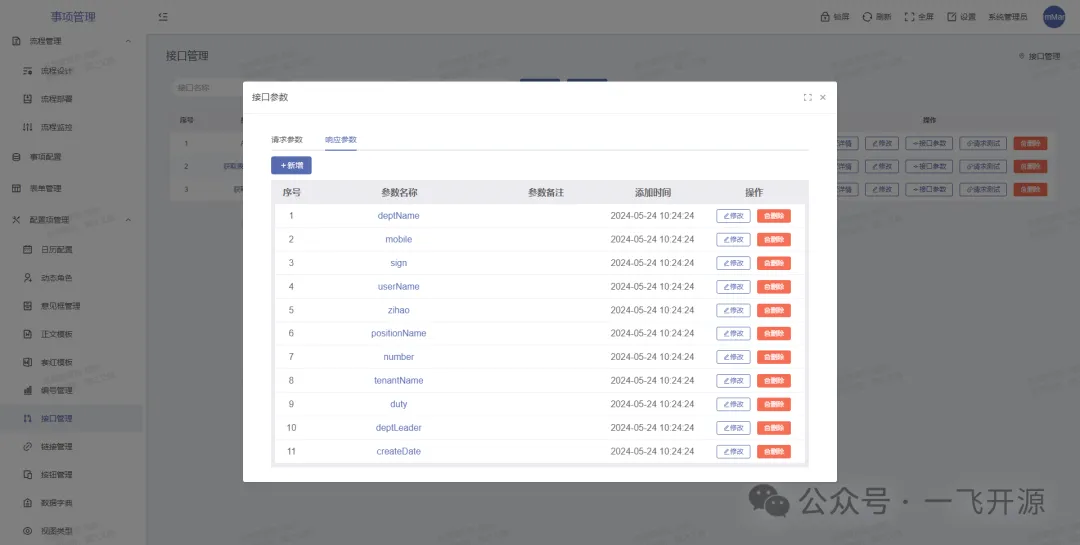
Task Management Screenshots
 |
 |
 |
 |
 |
 |
 |
 |
 |
 |
 |
 |
 |
 |
 |
 |
 |
 |
Workbench Screenshots
 |
 |
 |
 |
 |
 |
 |
 |
 |
 |
4. Feature Overview
Functional Architecture Diagram

1. The workbench's functionality and interface are configured through Task Management.
2. Task Management features are divided into three categories: workflows, forms, and configuration items.
3. Form Management handles database table structure mapping and design, supported by a drag-and-drop form engine.
4. Workflow Management covers workflow design, deployment, and monitoring, supported by a drag-and-drop workflow engine.
5. API Management supports integrating third-party APIs into workflow nodes and workflow paths.
6. Link Management supports binding third-party application entry points to job positions.
7. Document templates and red-header document templates require third-party plugin integration before they can be used.
Localization Features of the Engine
|
No. |
Feature Name |
Feature Description |
|
1 |
Sequential Processing |
Multiple users within a single workflow node receive pending tasks in a specified order and process them sequentially. The workflow automatically advances to the next node after all users have completed their tasks. |
|
2 |
Parallel Processing |
Multiple users within a single workflow node receive pending tasks simultaneously. The workflow automatically advances to the next node after all users have completed their tasks. |
|
3 |
Any-One Processing |
Within a single workflow node, regardless of whether tasks are processed sequentially or in parallel, the workflow automatically advances to the next node as soon as any one user completes their task (avoid using exclusive gateways). |
|
4 |
Weighted Voting |
Within a single workflow node, regardless of whether tasks are processed sequentially or in parallel, multiple users are assigned different voting weights. The workflow automatically advances to the next node when the voting weight exceeds X% (e.g., 60%) (avoid using exclusive gateways). |
|
5 |
Single-User Claim |
A single workflow node can assign tasks to multiple users simultaneously, but only one user can claim the task and process it. Once claimed, the task is no longer available to other users. Users can reject the claim or cancel an existing claim. |
|
6 |
Primary and Supporting Assignees |
A parallel workflow node supports defining primary and supporting assignees. Only the primary assignee can complete the task and proceed to the next workflow node. |
|
7 |
Subprocesses |
The main workflow can include subprocesses, allowing the main process and subprocesses to be handled independently. |
|
8 |
Automatic Execution |
Supports automatically triggering or skipping workflow paths and nodes, then proceeding to the next workflow node. |
|
9 |
Adding or Removing Assignees |
Supports adding or removing processing positions within the current workflow node. |
|
10 |
CC Notification |
Participants can notify other positions about the current workflow instance, regardless of its status. Repeated notifications are allowed. |
|
11 |
Workflow Redirection |
Supports redirecting the current workflow instance to any node. |
|
12 |
Delegation |
Delegates all tasks and workflow instances assigned to the current position to another position for processing. Supports configuring the delegation date range. |
|
13 |
Reminder |
Supports sending reminder notifications to processing positions from the In Progress task list. |
|
14 |
Return |
Supports returning the current workflow instance to the applicant (drafter) or to the sender of a previous workflow node. |
|
15 |
Recall |
Allows the sender to recall and reprocess a workflow task before the current assignee forwards it to the next node. |
|
16 |
Special Completion |
Supports directly completing a workflow instance from any workflow node. |
|
17 |
Expired Tasks |
Supports configuring an expiration time for each workflow node. The workflow instance status changes automatically after the expiration time is reached. |
|
18 |
Restore Pending Tasks |
Supports restarting the workflow of previously completed instances. |
Localization Features of the Engine
|
No. |
Feature Name |
Feature Description |
|
1 |
Task Configuration |
Provides centralized binding and management of all configuration items within the workflow engine. |
|
2 |
Form Configuration |
Supports flexible form configuration options, including action settings, data sources, field bindings, field validation, and style loading. |
|
3 |
Unified Pending Tasks |
Consolidates all pending task notifications into a unified interface for viewing and processing. |
|
4 |
API Configuration |
Supports configuring, testing, and invoking APIs from third-party systems, making it easy to integrate them into workflow paths and nodes. |
|
5 |
Link Configuration |
Supports binding and configuring the URLs of functional modules in third-party systems. |
|
6 |
Related Workflows |
Supports manually associating workflow instances in which users participate with the current workflow instance. Once associated, they can be opened together. |
|
7 |
Message Notifications |
Supports configuring message notifications for comments, approvals, and processing progress at workflow nodes of tasks currently in progress. |
|
8 |
Workflow Instance Migration |
Supports seamless migration of workflow instances from older versions to newer versions. |
|
9 |
Workflow Monitoring |
Supports real-time viewing and management of workflow instances, including deletion, suspension, activation, process diagrams, and variables. |
|
10 |
Advanced Search |
Supports searching workflow instances across all statuses and tasks associated with the currently logged-in user's positions. |
|
11 |
Document Templates |
Supports externally imported flow-based document templates for drafting document content (requires the document plugin). |
|
12 |
Red-Header Document Templates |
Supports externally imported flow-based red-header document templates, allowing red-header templates to be added after drafting document content (requires the document plugin). |
|
13 |
Communication |
Supports message-based communication among all personnel involved in processing or receiving carbon copies throughout the entire workflow instance lifecycle. |
|
14 |
Print Templates |
Supports configuring form information and Word templates for previewing and printing during workflow processing. |
|
15 |
Calendar Configuration |
Supports calculating working days and calendar days based on statutory holidays and national working-day adjustments, facilitating date rule calculations in workflows. |
|
16 |
Comment Configuration |
Supports configuring different types of comment boxes for different workflow nodes within a task, allowing comments from different positions to be displayed in separate sections. |
|
17 |
Dynamic Views |
Supports flexible configuration of display layouts for the Drafts, Pending Tasks, In Progress, and Completed lists. |
|
18 |
Numbering Configuration |
Supports authorizing designated positions to define field numbering rules at different workflow nodes within a task. |
Documentation Center
|
Sequence number |
Name |
|
1 |
Internal Java Development Standards Manual |
|
2 |
Logging Component Usage Documentation |
|
3 |
File Component Usage Documentation |
|
4 |
Code Generator Usage Documentation |
|
5 |
Configuration File Reference |
|
6 |
Common Utility Class Usage Examples |
|
7 |
Frontend Development Manual |
|
8 |
Frontend Development Standards |
|
9 |
Frontend Code Formatting |
|
10 |
Frontend System Components |
|
11 |
Frontend Common Methods |
|
12 |
Frontend Internationalization |
|
13 |
Frontend Icon Library |
|
14 |
Single Sign-On Integration Documentation |
|
16 |
Online Workflow Documentation |
|
17 |
Workflow WAR Package Deployment Guide |
|
18 |
Workflow Source Code Deployment Guide |
|
19 |
Workflow Operation Manual |
|
20 |
Workflow Management API Documentation |
|
21 |
Task Management API Documentation |
|
22 |
Work Item Processing API Documentation |
|
23 |
Oracle Database Compatibility Guide |
|
24 |
Dameng Database Compatibility Guide |
|
25 |
PostgreSQL Database Compatibility Guide |
|
26 |
Kingbase Database Compatibility Guide |
|
27 |
MariaDB Database Compatibility Guide |
|
28 |
OceanBase Database Compatibility Guide |
|
29 |
MySQL Database Compatibility Guide |
See the README.md documentation for details
5. Tech Stack
Source Code Directory
Logical Architecture Diagram

-
The workflow engine mainly consists of Task Configuration and the Workbench. Task Configuration is designed for operations personnel to configure workflows, while the Workbench is designed for users to interact with and use the system.
-
The workflow engine requires role and position configurations in the Digital Foundation; otherwise, it cannot operate.
-
The workflow engine supports not only traditional OA scenarios but also integration with and management of external business systems, algorithms, APIs, and agents.
Deployment Architecture Diagram

1. The workflow engine supports deployment and scaling through microservices, distributed architecture, and containerization.
2. The workflow engine requires additional servers for document preview services.
3. The workflow engine depends on the Digital Foundation and its Single Sign-On service.
4. In a domestic IT innovation environment, a standalone workflow engine can easily support 500 users on a virtual machine with 4 CPU cores and 8 GB of memory (historical data must be archived annually).
Backend Technology Stack
|
Sequence number |
Dependency |
Version |
|
1 |
Spring Boot |
2.7.10 |
|
2 |
SpringDataJPA |
2.7.10 |
|
3 |
SpringDataRedis |
2.7.10 |
|
4 |
SpringKafka |
2.8.11 |
|
5 |
nacos |
2.2.1 |
|
6 |
druid |
1.2.16 |
|
7 |
Jackson |
2.13.5 |
|
8 |
javers |
6.13.0 |
|
9 |
lombok |
1.18.26 |
|
10 |
logback |
1.2.11 |
|
11 |
flowable |
6.8.0 |
Frontend Technology Stack
|
Sequence number |
Dependency |
Version |
|
1 |
vue |
3.3.2 |
|
2 |
vite2 |
2.9.13 |
|
3 |
vue-router |
4.0.13 |
|
4 |
pinia |
2.0.11 |
|
5 |
axios |
0.24.0 |
|
6 |
typescript |
4.5.4 |
|
7 |
core-js |
3.20.1 |
|
8 |
element-plus |
2.2.29 |
|
9 |
sass |
1.58.0 |
|
10 |
animate.css |
4.1.1 |
|
11 |
vxe-table |
4.3.5 |
|
12 |
echarts |
5.3.2 |
|
13 |
svgo |
1.3.2 |
|
14 |
lodash |
4.17.21 |
Middleware Selection
|
Sequence number |
Tools |
Version |
|
1 |
JDK |
11 |
|
2 |
Tomcat |
9.0+ |
|
3 |
Kafka |
2.6+ |
|
4 |
filezilla server |
1.7+ |
Database Selection
|
Sequence number |
Tools |
Version |
|
1 |
Mysql |
5.7 / 8.0+ |
|
2 |
Redis |
6.2+ |
|
3 |
elasticsearch |
7.9+ |
Workflow Engine Patents
|
No. |
Patent Number |
Patent Title |
|
1 |
ZL202210221266.3 |
"A Workflow Synchronization Update Method and Workflow Synchronization Update System Based on Global State Updates" |
|
2 |
ZL202210222170.X |
"A Workflow Data Recovery Method and Data Recovery System" |
|
3 |
ZL202210803411.9 |
"An Implementation Method for a Workflow Engine Containing Multiple Starting Points and Multiple Branches" |
Domestic IT Innovation Compatibility and Adaptation
|
Sequence number |
Type |
Category |
|
1 |
Browser |
Qi-Anxin, Firefox, Google Chrome, 360, etc. |
|
2 |
Plugin |
Kingsoft, Yongzhong, Dsofr, Foxit, etc. |
|
3 |
Middleware |
TongTech, Kingdee, Beyondsoft, etc. |
|
4 |
Database |
Kingbase, Dameng, GaussDB, etc. |
|
5 |
Operating System |
UnionTech UOS, Kylin, NeoKylin, etc. |
|
6 |
Processors |
ARM architecture, MIPS architecture, X86 architecture |