[Open Source] Enterprise-Grade Local Knowledge Base Q&A Solution for Any File Format or Database

1. Project Overview
Ask Anything
An open-source, enterprise-grade, on-premises knowledge base question-answering solution designed to support Q&A over files in any format or databases.
What Is QAnything?
QAnything (Question and Answer based on Anything) is an on-premises knowledge base question-answering system designed to support files in any format or databases. It can be installed and used offline.
You can upload local files in any format to get accurate, fast, and reliable question-answering experiences.
Currently supported formats: PDF(pdf), Word(docx), PPT(pptx), XLS(xlsx), Markdown(md), Email(eml), TXT(txt), Images(jpg, jpeg, png), CSV(csv), and Web Links(html).
2. Open Source License
Licensed under Apache-2.0
3. Screenshots


4. Feature Overview
Features
-
Your data is secure. Installation and usage are fully supported without an internet connection.
-
Supports cross-language question answering. You can switch freely between Chinese and English, regardless of the language of your files.
-
Supports question answering over massive datasets. Two-stage vector retrieval and reranking solve the retrieval degradation problem associated with large-scale data. The more data you have, the better the results.
-
A high-performance, production-grade system ready for direct deployment in enterprise applications.
-
Easy to use, with no complicated configuration required. Install and deploy with one click, then start using it immediately.
-
Supports question answering across multiple selected knowledge bases.
5. Tech Stack
Architecture
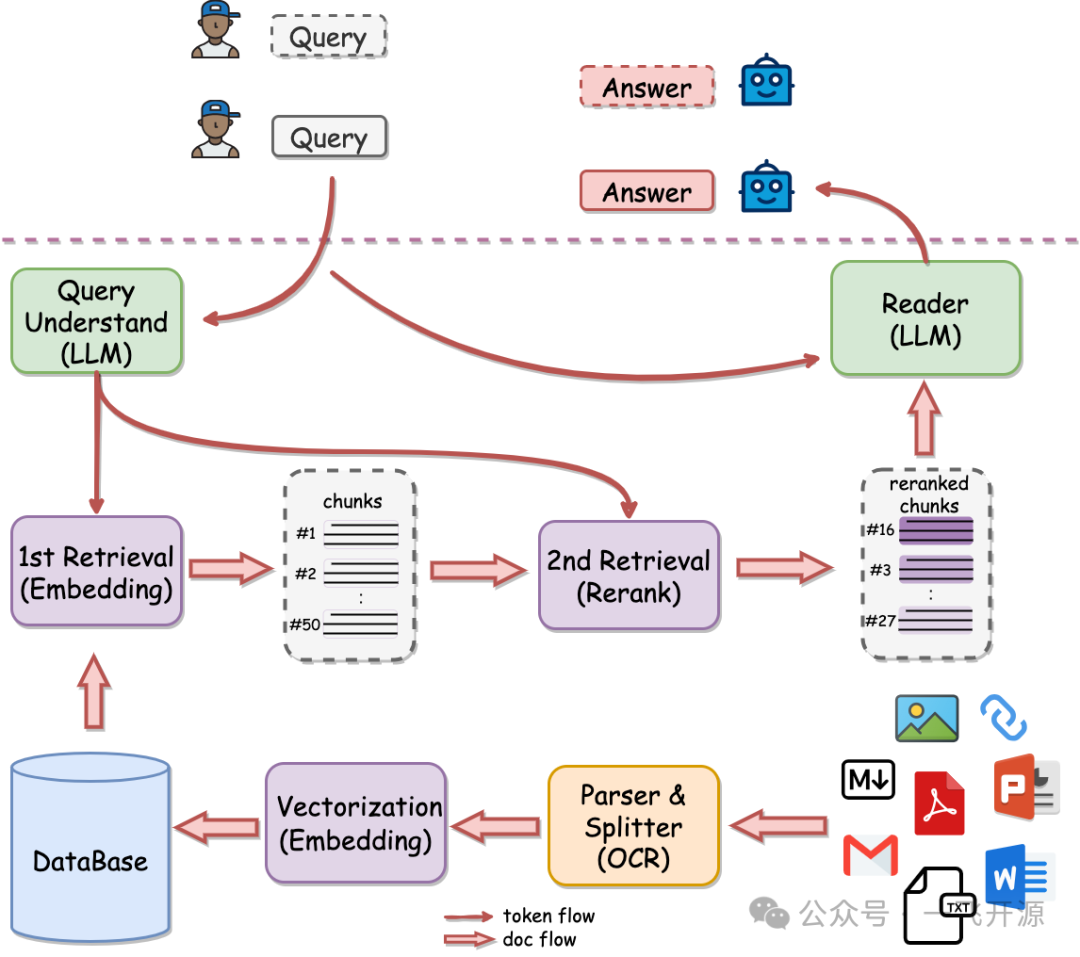
Why use two-stage retrieval?
The advantages of two-stage retrieval are particularly evident when working with large knowledge bases. Using only one-stage embedding retrieval leads to retrieval degradation as the dataset grows, as illustrated by the green line in the figure below. The second-stage reranking process stabilizes and improves accuracy, meaning the more data you have, the better the results.

LLM
The open-source version of QAnything uses Tongyi Qianwen as its underlying large language model and has been fine-tuned on extensive professional question-answering datasets. It significantly enhances question-answering capabilities based on Qianwen. For commercial use, please comply with Qianwen's license. For details, please refer to: Tongyi Qianwen.
Start
System Requirements
For Linux
|
System |
Required item |
Minimum Requirement |
Note |
|
Linux |
NVIDIA GPU Memory |
>= 4GB (use OpenAI API) |
Minimum: GTX 1050Ti (use OpenAI API) |
|
NVIDIA Driver Version |
>= 525.105.17 |
||
|
Docker version |
>= 20.10.5 |
Docker install |
|
|
docker compose version |
>= 2.23.3 |
docker compose install |
|
|
git-lfs |
git-lfs install |
For Windows with WSL Ubuntu subsystem
|
System |
Required item |
Minimum Requirement |
Note |
|
Windows with WSL Ubuntu subsystem |
NVIDIA GPU Memory |
>= 4GB (use OpenAI API) |
Minimum: GTX 1050Ti (use OpenAI API) |
|
GEFORCE EXPERIENCE |
>= 546.33 |
GEFORCE EXPERIENCE download |
|
|
Docker Desktop |
>= 4.26.1(131620) |
Docker Desktop for Windows |
|
|
git-lfs |
git-lfs install |
More content, please refer to README.md document